Smoke fills the air we breathe
Landfills, kilns, and vehicles combine to bring pollution to dangerous levels
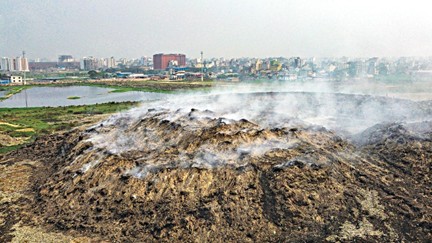
Smoke from the Matuile and Amin Bazaar landfills frequently covers the sky in Dhaka, showing that poor waste management has become a major contributor to urban air pollution. Waste collectors frequently burn garbage on highways outside the capital. These practices, along with emissions from brick kilns and vehicles, as well as dust from roads and construction sites, further worsen the already toxic city air. According to the Swiss-based Air Quality Index (AQI), Dhaka’s atmosphere is often ranked as the most polluted region in the world. The average AQI in Dhaka and its vicinity consistently hovers around 200, sometimes exceeding 600.
Yesterday, Dhaka’s air quality was the third worst in the world after Karachi and Beijing, and Bangladesh’s overall average air quality was the second worst in the world. On the AQI scale, 0-50 is classified as ‘good’, 51-100 as ‘moderate’, 101-150 as ‘harmful to sensitive populations’, 151-200 as ‘unhealthy’, 201-300 as ‘very unhealthy’, and above 300 as ‘risk’. As of March 4, Savar’s AQI was 640. Jiaul Haq, head of the CASE project at the Ministry of Environment, said that the air pollution that is noticeable in Dhaka this winter and after winter is mainly due to smoke from the Amin Bazaar and the Matuil landfill.
Matuile: Waste heaps up to 80 feet high
Last Saturday morning, even though the sun was shining, the sky was covered in thick fog and the smoke was clearly visible. During a site visit to the Matual landfill, they found a 100-acre site littered with piles of waste ranging from 50 feet to 80 feet high. One grave, mostly made of polyethylene, was on fire, with columns of smoke swirling upwards. Sanitation workers at the scene claimed that the fires occurred spontaneously and that no one started them intentionally. Sanitation worker Md Harun pointed out that fires occur every day, and once they catch fire, they will continue to burn unless the fire department intervenes. “This morning,” he said in an interview with this reporter, “the fire department came to extinguish the fire that had previously occurred. But it’s not completely turned off.”
Henna Begum, who has been collecting and selling polyethylene at the Matual dump for five years, said the frequency of fires has increased this year. “Because of the fire and smoke here, we couldn’t come to the site for several days.” Previously, the Ministry of Environment built an organic fertilizer plant in Matuayle with funds from the Climate Change Trust Fund, but it is no longer working. Nasir-Uddin Buiyan, who recently took charge of the plant’s operations, explained that about 80% of incoming waste, such as polyethylene, is not biodegradable .
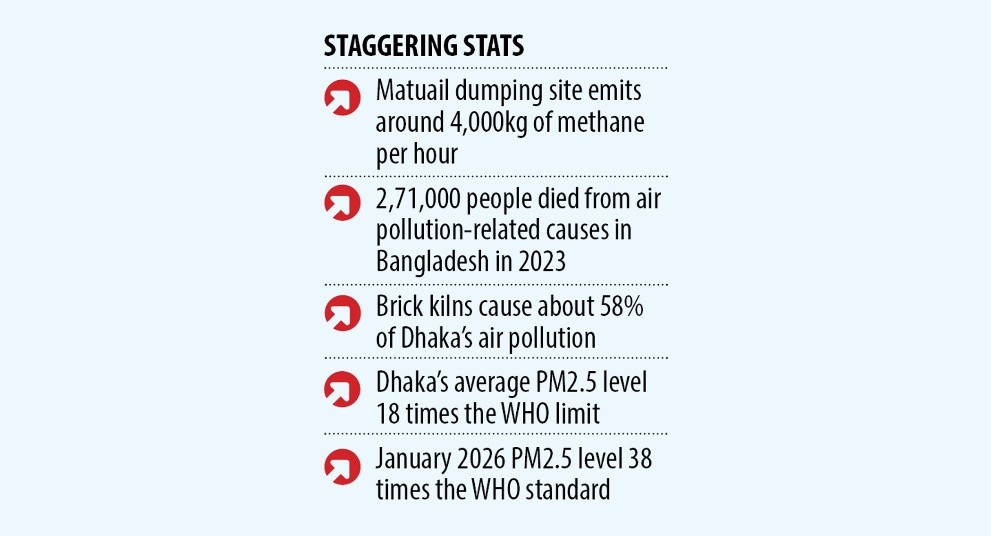
He said the plant plans to produce fertilizer from the remaining 20% and will start operating soon. He also noted that the methane gas generated from this waste pile continues the fire after ignition. Dr . Mohammed Shafiullah Siddiq Bouiya, Supervising Engineer of the Waste Management Directorate of Dhaka South City Corporation, also said that these fires occur spontaneously. “Waste has accumulated on the site for 35 to 40 years, forming multiple layers that have accumulated methane and greenhouse gases. When everyday waste accumulates, the presence of flammable materials can react with the accumulated methane and cause fires.” According to a 2023 article by Dev Patel published by Harvard University, the Matual site emits 4,000 kilograms of methane gas per hour.
Waste-filled road to Kumila
On the way to Kumila, leaving the Matual site, sanitation workers were seen setting fire to a small garbage pile that started in Jatrabari. Further along the highway, there were numerous piles of garbage lined up on the side of the road. In some areas, waste was scattered to prevent the pile from getting too high. Numerous burning or smoking piles of waste were observed on both sides of Jatravari, Narayanganji, Gajaria, Nimsar, Burichan, Shadawlatpur and Varura roads. Rashidul Hassan, a scrap metal dealer in Chandina, was transporting coal from polyethylene stocks. “Polyethylene destroys the environment, so I collect it and burn it every time I find it.”
Savard: The Declined Airshed
Arriving in Sabbar, the correspondent saw seven or eight men of various ages sitting under a tree in the Nagarkonda area at noon on Sunday. As they approached, a middle-aged man shouted. “Our lives are cursed. What more do you want to know from us?” The man said Tayev Miaro, a farmer and permanent resident of the area, said they live right next to the Amin Bazar landfill. Here, the smoke of mixed polyethene waste has been suffocating the locals for two months. “I don’t want to talk about this anymore; What’s the use of telling me?” he asked, leaving his seat frustrated.
In August last year, the then government declared the Sabbar region a poor air warehouse, and since September, 106 brick kilns have ceased to operate, except for the “tunnel kilns” and “hybrid Hoffmann kilns”. The government also prohibited the issuance of permits for open-air incineration of solid waste and industries that could cause air pollution in the notice. Nevertheless, the smoke from the Amin Bazaar garbage dump poses a significant health risk to local residents. “In addition, about 30 to 40 brick kilns have been reopened as the owners resumed operations last month with permission from the High Court,” said Mohammad Abdul Motalib, Deputy Director General of the Ministry of Education.
When visiting the Ronnie Briggs Company in the Sabbar Bakurta area, a notice was posted at the entrance citing the instructions of the High Authorities, requesting the relevant authorities not to interfere with its operations under the order of Petition No. 15982/2025. Enayet Hossein, who oversees the kiln, told the Daily Star that the Ministry of Higher Education gave him a six-month operating permit after filing a petition citing financial losses. He argued that many other kiln owners in Sávar are also operating under similar court directives. According to sources from the Ministry of Education, brick kilns account for about 58% of all air pollution in Dhaka. Along with solid waste incineration, smoke from industrial and brick kilns, and emissions from old vehicles which is considered a major pollutant in Dhaka’s atmosphere.
PM2.5 rises; Waiting for the authorities
According to the annual report on the Global Air Quality Life Index published by the University of Chicago’s Energy Policy Institute, between 1998 and 2023, the country’s PM2.5 pollution surged by 66%. Last year, Dhaka’s average annual PM2.5 reading was 90.35 micrograms per cubic meter, about 18 times the WHO’s recommended annual threshold of 5 micrograms per cubic meter. Typically, during the dry season, PM2.5 levels rise sharply compared to other months. In January 2026, the average PM2.5 concentration in Dhaka rose to 193/193, which is 38 times higher than the WHO standard.
Breathe toxic air
According to a global report, in 2023 alone, 271,000 people died from air pollution-related causes in Bangladesh. More than 90% of these deaths are linked to non-communicable diseases such as heart and lung disease, diabetes, and dementia, according to the sixth Global State of Air report.
2026.03.14 THE DAILY STAR